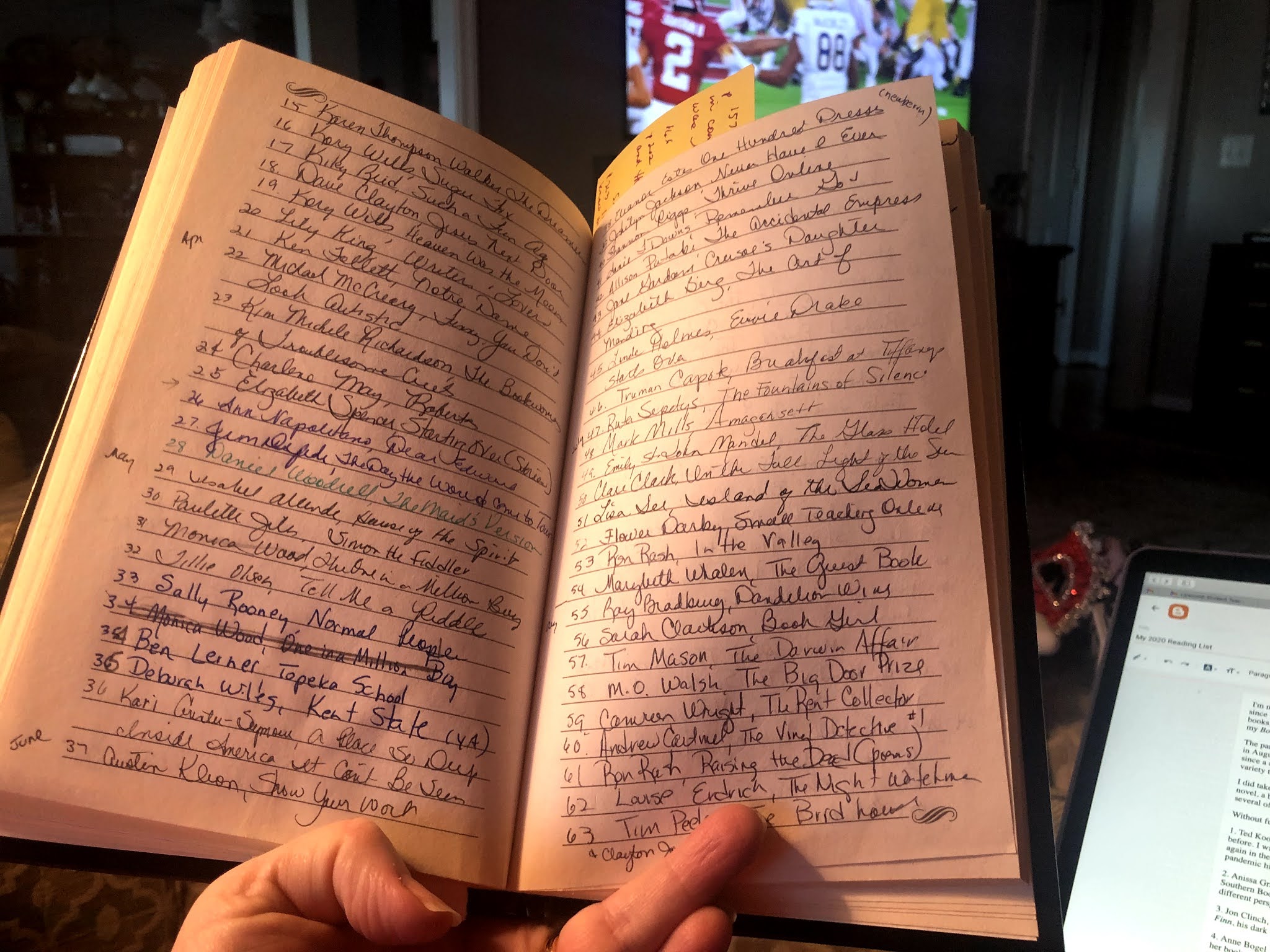
I'm not sure how many years now I have been sharing the list of books I read. I have kept up methodically since 1997. That may be the year I read that Art Garfunkel has kept his list since he was 16. As I finish books, I list them on my kitchen calendar (a gift from my son John each year). At year's end, I transfer to my
Book-Woman notebook.
The pandemic may have given me more time to read for pleasure, even though starting a doctoral program in August added to my non-discretionary reading. (By the way, I only listed one or two of those books, since a chapter or two may have gone unassigned). Still, I am pleased with the list--the numbers but the variety too.
I did take on a "2020 Reading Challenge" from the Modern Mrs. Darcy website, which included a debut novel, a book by a local author, three books by the same author, and more. I've already written about several of these books over the past year, so I'll just include a blurb for each.
Without further ado, here's the list. Posts on a few specific books will follow in the next few days:
1. Ted Kooser, Poetry Home Repair Manual. I had read this wonderful volume by the former poet laureate before. I was reminded just how useful and practical it is for any kind of writer. I had hoped to see Kooser again in the summer's Christian Scholars Conference, but his health caused him to cancel even before the pandemic hit.
2. Anissa Gray, The Care and Feeding of Ravenously Hungry Girls. Gray appeared in a panel at 2019's Southern Book Festival, but it took me awhile to get to this story of a mother and her daughters from their different perspectives.
3. Jon Clinch, Marley. This alternative tale of the Christmas Carol story nudges me to go back and read Finn, his dark (I hear) tale of Huck's father.
4. Anne Bogel, Reading People. I enjoy Bogel's Modern Mrs. Darcy's emails and blog posts, as well as her books, usually book-related. This book gives a taste of a number of inventories of personality and temperament from Myers-Briggs to the Love Languages and the Enneagram.
5. Kent Haruff, Where You Once Belonged. I discovered Haruff via his Plainsong and Eventide, which I accidentally read out of order. His subtle books with engaging characters stick with me.
6. Yangsze Choo, The Night Tiger. This book recommendation came from my daughter-in-law, also a voracious reader. It follows a mysterious death, apparently by a tiger, through the eyes of a girl working at a dance hall, a secret she keeps from her mother.
7. Markus Zusak, I Am the Messenger. While this book is not at all like The Book Thief, Zusak demonstrates that he can tell more than one kind of story. A young man without much of a future receives a message informing him of responsibilities that change his life.
8. Jeanine Cummins, American Dirt. Cummins appeared at Parnassus to read from her novel within about a day of the pushback about whether or not she had the right to tell the story of a Mexican mother and child attempting to migrate to the United States. (Dead authors were probably spinning in their graves, awaiting the verdict on their on appropriation.) Personally, I felt she presented multiple perspectives in a way that should open up more dialogue and encourage readers to seek to understand.
9. Joshilyn Jackson, Almost Sisters. I've been reading Jackson's unquestionably Southern novels since Gods in Alabama. This year, I read three (as part of my reading challenge). This one had a hilarious scene when the narrator's grandmother, suffering from Lewy body dementia, lets loose with the truth at a church covered dish dinner. As usual in her books, the mood moves easily between funny and serious.
10. Jojo Moyes, The Giver of the Stars. I read this book about the Kentucky pack librarians before I read The Bookwoman of Troublesome Creek. I think Moyes' attempt to flesh out the Southern women was a weakness of the book. I have also heard a lot of suggestions that she borrowed some plot devices from the other book.
11. Tommy Tomlinson, The Elephant in the Room. I have loved Tomlinson's writing since he worked as a columnist for the Charlotte Observer. The piece that ran on his wedding day (which he includes in this book) is a valued part of my permanent files of great writing. The overarching idea of the book is Tomlinson's lifelong struggle with weight (which he is addressing sensibly and gradually), giving the book title its double meaning. This is also a love story, in my humble opinion.
12. Mike James, The Journeyman's Suitcase. James was one of the featured readers in our Black Dog Open Mic Poetry series (before the pandemic pushed us to Zoom). I was pleasantly surprised that we had lived in NC at the same time and shared many poetry friends. I hope to read more of his poetry.
13. Malaika Albrecht, Lessons in Forgetting. I re-read Malaika's poems the follow her mother's Alzheimer's. I have given copies of this book to other friends who are navigating this same difficult path, this tender burden.
14. Robert Galbraith, Lethal White. When I read these novels by J. K. Rowling, under her pseudonym, I honestly forget she is the author. While the books bear no resemblance to the Harry Potter story, her writing, her characterization are just as strong. I love Cormoran Strike and his protégée Robin.
15. Karen Thompson Walker, The Dreamers. When I heard Walker at the Southern Book Festival on the same panel as Anissa Gray, I had read her debut novel The Age of Miracles. I read this book in the early days of the Covid-19 pandemic and found eerie the parallels between the sleeping virus in her novel and the virus we were beginning to face.
16. Kory Well, Sugar Fix. Murfreesboro poet Kory Wells read for the Black Dog open mic. I love her voice, when comes through in her poems on the page as well as they do when she reads them (so well). The cover on the book is a bonus too.
17. Kiley Reid, Such a Fun Age. Reid appeared at Parnassus Books (back when that was still happening live) to discuss her debut novel with Ann Patchett. The racial currents of the book are only a part of the tensions of this well-told story.
18. Dave Clayton, Jesus Next Door. One of the bright spots of the beginning of 2020 was Awaken Nashville, a season of prayer and fasting focusing on those who live around us. I believe this was great preparation for what hit us in March, when suddenly neighbors came out of doors for fresh air and met each other. This little book led us through the month. I'll read it again this year.
19. Kory Wells, Heaven Was the Moon. See #16. Reading one book of Wells' poems led to another.
20. Lily King, Writers and Lovers. My book club had read and enjoyed Euphoria, also by King. This story of a young aspiring writer, dealing with mounting college debt while waiting tables was completely different and completely engaging.
21. Ken Follett, Notre Dame. Follett, whose novels have drawn attention to centuries of European cathedrals, wrote this slim volume after the terrible fire. I believe the proceeds are going to the repairs.
22. Michael McCreary, Funny, You Don't Look Autistic. This library "all read" is a young man's memoirs (nervy, he admits--writing a memoir in his early 20s). He manages to dispel stereotypes about autism in a humorous, human way.
23. Kim Michele Richardson The Bookwoman of Troublesome Creek. See #10. Another story of the packhorse libraries of Kentucky during FDR's administration, this also had me Googling the "blue people" of that region. Yes, they're real.
24. Charlene May, Roberta. Charlene May and her husband ran the guest house in Port-au-Prince when I traveled there with Healing Hands International a few years ago. She has written the story of Roberta Edwards, the amazing woman who kept all our efforts there coordinated as she ran a children's home for more than 20 children--before her senseless murder about six years ago.
25. Elizabeth Spencer, Starting Over (Stories). This year, I made an effort to pick up the still-unread books on my shelf. This collection was one of my Lemuria Books First Editions Club selections.
26. Ann Napolitano, Dear Edward. I loved Napolitano's book A Good Hard Look (in which Flannery O'Connor appears as a secondary character). This is the story of a young boy who is the sole survivor of a plane crash in which his entire family died. He is dealing with his own survivor's guilt as his mother's sister's family tries to help him build a new life.
27. Jim Defede, The Day the World Came to Town. I have been fascinated by the story of the people of Gander, Newfoundland, who welcomed the passengers on planes diverted from the U.S. after the incidents of 9/11. Defede gives glimpses of the locals who showed hospitality above and beyond expectations and put faces on the passengers and crew whose lives were put on hold.
28. Daniel Woodrell, The Maid's Version. This is another of my Lemuria books I hadn't read yet.
29. Isabel Allende, House of the Spirits. This was a re-read as part of my book club. It had been long enough since I first read this novel that it was like a fresh reading. I was also pleasantly surprised to find Allende's phone number--written in her hand--from when my friend Kim and I talked to her when she read in Hickory, NC, several years ago. I know some people don't like magical realism--but I do. She does it well.
30. Paulette Jiles, Simon the Fiddler. I loved News of the World (and look forward to seeing the movie), so I couldn't resist this novel the picks up with the story of a minor character from that novel. Set in Texas at the end of the Civil War, this one also produces a great old-time play list.
31. Monica Wood, The One-in-a-Million Boy. I think I loved this book as much as anything I read this year. I'm a huge proponent of collection of oral history, which is one small part of this tender story of what begins as a relationship between a centenarian and a young Boy Scout but that touches his family as well.
32. Tillie Olsen, Tell Me a Riddle. I don't know that I'd ever read anything by Olsen but her much anthologized short story "I Stand Here Ironing." Sometimes I forget how much I love a well-written short story.
33. Sally Rooney, Normal People. Maybe "normal" is an overstatement, Sally. But the relationships between the characters in this novel certainly pulled me in. Isn't this a series?
34. Ben Lerner, Topeka School. This book goes a lot of different directions with the recurring theme of unintelligible speech, but the portray of high school cross-x debate competition is so spot on. Having spent at least five years of my life driving a van full of debaters around the country, I suspect Lerner has been on similar road trips.
35. Deborah Wiles, Kent State. This is one of the Parnassus Next selections of young adult fiction. Told in different voices, she presents the many sides to the story known to many mainly through the song by Crosby, Stills, and Nash.
36. Kari Gunter-Seymour, A Place So Deep Inside America It Can't Be Seen. Kari has participated in our Black Dog open mics, so I was glad to discover her work. Now the Ohio poet laureate, she seeks out voices of Appalachian women poets.
37. Austin Kleon, Show Your Work. Kleon's little books are among my frequent recommendations. They can be read in a sitting and they just make good sense--in such a clever way.
38. Eleanor Estes, One Hundred Dresses. This Caldecott Medal picture/storybook is a good example of a children's book that speaks to adults on a different level.
39. Joshilyn Jackson, Never Have I Ever. This book by Jackson is the nightmare of a book club gone wrong. Anybody in one knows how one person with an agenda can hijack the process. This story is the extreme that might happen when a new neighbor decides to expose long-hidden secrets.
40. Shannon Riggs, Thrive Online. This book was one of the summer book clubs selections for Lipscomb faculty intent on making the best of our new reality--teaching with technology. Riggs' point is that online education doesn't have to be a second-best alternative but can actually be used to teach well.
41. Annie T. Downs, Remember God. This book was "assigned" by a dear friend to a small circle of us who have tried to keep connections during the pandemic. Our assignment--by the end of the year to give a word to each other for 2021. Heaven knows we need a new one.
42. Allison Pataki, The Accidental Empress. This work of historical fiction tells the story of a second daughter who married the heir apparent to the Austro Hungarian empire. She found herself manipulated by her mother-in-law, who took control of her children. Further reading about the real Elisabeth (known as Sisi), considered the Austrian Cinderella, led to some very surprising facts about this woman's life.
43. Jane Gardam, Crusoe's Daughter. I had received copies of some of Gardam's novels a while back and finally read Old Filth, which I found a fascinating read. This story was also a great read, with setting a major part of the story for me.
44. Elizabeth Berg, The Art of Mending. This is another story of a family uncovering secrets during an annual family visit during the state fair. The protagonist works as a quilter, which provides a nice metaphor throughout the novel.
45. Linda Holmes, Evvie Drake Starts Over. Evvie, the main character of this story, is ready to make a change in her life, when circumstances are taken out of her hands. Through a friend, she is introduced to a baseball player who washed up, thanks to the "yips." Their relationship and her platonic relationship with the friend who introduced them are strained as they develop under the watchful eye of the local residents and family.
46. Truman Capote Breakfast at Tiffany's. I confess that I had never watched the iconic film based on Capote's novella that makes up part of this collection (which also includes my all-time favorite holiday story "A Christmas Memory.") I was surprised. I forgot to listen for strains of "Moon River."
47. Ruta Sepetys, The Fountains of Silence. Another of Parnassus Books' YA selections, this novel by Nashville author Sepetys easily crosses over into adult reading. Set in Franco's Spain, the story follows a young American with his diplomatic family as his interest in photography gets him caught up with a local woman who works as a maid, after her family loses status during political upheaval.
48. Mark Mills, Amagansett. This book had been recommended by teaching colleague years ago. The story takes place between two worlds--the local New England fishermen and the wealthy summer residents. The plot begins with a body caught in a fishing net and follows the policeman investigating and the fisherman who recovered the body.
49. Emily St. John Mandel, The Glass Hotel. From the author of post-apocalyptic Station Eleven, this novel follows a young woman who takes on a new identity through her relationship with a man who becomes caught up in a Madoff-type scheme.
50. Clare Clark, In the Full Light of the Sun. I love a novel that delves into the art world. This one focuses on paintings that may or may not have been painted by Van Gogh, through the lives of artists, collectors, and other art world personalities in Berlin during the Nazi rise to power.
51. Lisa See, The Island of the Sea Women. See's novels always feel a little bit like travel--or time travel. This story of the women of the remote Korean Island of Jeju who have been physically conditioned to dive for sea creatures in even the coldest conditions during Japanese occupation.
52. Flower Darby, Small Teaching Online. This is the second book our faculty book club read to prepare for the inevitable online component of our teaching in the fall. I need to give a shout-out to our Center for Teaching and Learning (CTL) staff, who were ready to offer the support we needed.
53. Ron Rash, In the Valley. If Ron Rash writes it, I'm going to read it--fiction or poetry. This collection has short stories set in Western North Carolina, along with the title novella, a sequel to his novel Serena. He does not disappoint.
54. Marybeth Whalen, The Guest Book. This is the epitome of a beach read, the story of a young woman returning to the beach house her family used to visit annually--until her father's death. Trying to look beyond the relationship with the father of her daughter, she hopes to find the identity of the young man with whom she had exchanged messages and drawings in the beach house guest book.
55. Ray Bradbury, Dandelion Wine. As I mentioned in my post about the one, Dandelion Wine is a perfect summer read--nostalgia, a little touch of magical realism, a coming of age story.
56. Sarah Clarkson, Book Girl. This book's title is deceptive. There is a depth to this literary memoir by Clarkson who studied at Oxford, a dream that began with her fascination with C. S. Lewis. I could probably spend a year reading through the book lists she provides.
57. Tim Mason, The Darwin Affair. I read this library city read on recommendation from my book friend George. It's a mystery that has Victoria and Albert, Charles Darwin, and Dickens in the background.
58. M. O. Walsh, The Big Door Prize. Walsh was part of the "big reveal" held online for this year's Souther Festival of Books. The book is dedicated to John Prine (one of this year's great losses). The title is, of course, a reference to Prine and Iris Dement's "In Spite of Ourselves." The chapter titles and even some minor characters are a great scavenger hunt for Prine fans in what is essentially a clever Southern story about a high school teacher and his wife who consider their dreams and question their life's potential.
59. Camron Wright, The Rent Collector. This was another of my favorites this year an incredibly uplifting story set in a trash dump in Cambodia. Among other things, it's a story of redemption and second chances and an homage to the power of literature.
60. Andrew Cartmel, The Vinyl Collector #1. In what is evidently the first of a series, this is the story of a young man who seeks and sells rare vinyl records who is hired to find a particular album, leading him on a path of romance, danger, and intrigue.
61. Ron Rash, Raising the Dead. (poems) Reading Rash's story collection sent me to my poetry shelf to revisit this collection of poems. I recall his suggesting that he wrote novels so his publishers would let him release volumes of poetry. I'm glad they do.
62. Louise Erdrich, The Night Watchman. I don't think I've met an Erdrich novel I didn't like. The characters in this book live up to the standard she has set. I recall teaching "The Red Convertible" to high school seniors and learning that one of the students and her mother went on to read other Erdrich stories and novels together.
63. Tim Peeler, The Birdhouse. (illustrated by Clayton Joe Young) Peeler is a friend and an excellent poet whose poems come from all kinds of inspirations--his love for baseball, his former job as a hotel desk clerk, and in this slim volume, his experience working in the community college. The speaker/narrator is a young woman going to college and rethinking her relationship with her husband. Most of the narrative and interior monologue take place during the time it takes for him to mow their property. Young's photographs are an ideal complement.
64. William Kent Krueger, This Tender Land. This story is told by a young man who has landed with his brother in a school for orphaned Native American boys after losing his parents. The cruelty of those charged with caring for the boys and the loss of a potential mother figure sends the boys, with a young orphaned girl and a friend left mute on an Mark Twain style adventure, bringing them into the circle of a traveling tent revival crew.
65. Louise Penny, All the Devils Are Here. The worst thing about finishing a Louise Penny is knowing I have to wait for her to finish writing and to publish the next in her Inspector Gamache series. As I have oft repeated, I tend to avoid mysteries and series, but these are the most literate stories with characters I have come to know. A friend told me, "I rarely cry over a book but this one made me week--with joy." Enough said.
66. Megha Majumber. A Burning. This disturbing narrative is set in Indian as a young girl by coincidence is accused of assisting in a terrorist train bombing and sentenced. All the people in her life who might help her avoid unjust punishment are self-motivated to do otherwise.
67. Brene Brown, Dare to Lead. Since I've been studying leadership this semester, this book by Brown was a good companion read. I've often used her TED Talk "The Power of Vulnerability" in my composition class. I like her common sense approach and her self-awareness too.
68. Ann Mah, The Last Vintage. This book shifts back and forth between the present and the WWII past when a daughter is a party to her father's hiding of the family's special wine vintage. In the modern part of the story, a young woman related to the family spends time on the family's Burgundy estate as she prepares to take the Master off Wine exam. She and the college friend married to her cousin find writings that convinces them a relative acted ignobly during the war.
69. Yaa Gyasi, Transcendent Kingdom. Gyasi has drawn from her own story to create Gifty, the protagonist of this novel about a young woman whose parents immigrated to Huntsville, Alabama, from Ghana. She loses her brother to addiction, following from a sports injury, and goes on to do her post-doctoral work on the brain, spending her days observing and manipulating her lab mice and caring for her mother who suffers from depression.
70. Camron Wright, The Orphan Keeper. After reading The Rent Collector, my mother went on to read this other novel by Wright, also based on a true story. In this one, a young Indian boy is kidnapped by people running an orphanage that supplies children for adoption to Americans. The parents who adopt this boy are unaware for years that he had living parents. His marriage, a love match that has to overcome his wife's parents' desire for an arranged marriage, gives him the opportunity to search for his real story.
71. Wendy Cope, Two Cures for Love. (poems) When my cousin asked for British poets whose poems weren't so dark, I got this suggestion from another colleague. I'm glad I did. The poems are almost in conversation with other works of literature, sometimes playful, sometimes serious. Cope may draw from another poem's form or allude to other elements. While I wanted to pick apart the references myself, she provides explanations and elaborations in the appendix to the volume. Fun.
72. Richard Powers, The Overstory. This book kept coming up in other people's reading lists. It's hard to describe the book to others without just saying that it's a group of inter-related stories, all in some way about trees. It was one of the more powerful books I read this year.
73. Leman and Pentak, The Way of the Shepherd. This is one of the books I was assigned in my classes this semester. This book is presented as a secondhand telling of lessons in leadership, with the idea of passing along the lessons learned. The original "shepherd" is a mentor who shares his leadership secrets with illustrations from his avocation, raising sheep.
74. C. S. Lewis, The Magician's Nephew. I had long ago read Lewis's The Lion, the Witch, and and Wardrobe, but decided to work through the Narnia series in chronological order. Even the guy who checked me out at Krogers said he had given away several of his own sets.
75. Taylor Jenkins Reid, The Seven Husbands of Evelyn Hugo. From the author of Daisy Jones and the Six, this is a story with a similar journalistic mode. A young journalist is given the opportunity to interview an aging Hollywood star who has kept private the truth of her real love life.
76. Lisa Wingate, The Book of Lost Friends. I checked out the audio of this book from the library, only to have it snatched off my devices after 14 days. I had to wait weeks to finish it, but I'm glad I did. It's another of those stories set in two times--1987 and immediate post-Civil War. In one story, a former slave is seeking her lost family, as are so many others. In the modern story, a beginning teacher finally engages her reluctant students by inspiring them to uncover their own family stories.
77. Lee Smith, Blue Marlin. I'd say the only thing better than reading Lee Smith's fiction is hearing her read it. However, on the page, it's so easy to hear her voice. I especially love that after the end of the story, she has an epilogue in which she distinguishes between the events in her fictional plot and those in her own childhood. That part is excellent instruction for any aspiring memoirist.
78. I.C. Robledo, Practical Memory. This book offers lots of tips for enhancing one's memory for day-to-day activities (as opposed to memory competition found in Foer's Moonwalking with Einstein.)
79. Will Shorr, The Science of Storytelling. Part writing advice, part literature study, part brain-based, Shorr draws from literary and cinematic examples for a compelling book I expect to read again. And again.
80. Carol Burnett, In Such Good Company. It's hard not to love Carol Burnett. As she revisits the years of her television show, she has such gracious remembrances of her co-stars and guests. To prepare for the memoir, she watched all the episodes of all the years of the Carol Burnett Show. I couldn't help thinking how fun it might be to watch them with her. This came close.
81. Howard Gardner, Five Minds for the Future. Known for his "multiple intelligences," Gardner focuses in this book on the "five minds" that should be developed--the disciplined mind, the synthesizing mind, the creating mind, the respectful mind, and the ethical mind. Between the lines, Gardner answers the recurring student question: Why do I need to know this?
82. Taylor Mali, What Teachers Make. Poet and former teacher Mali gained fame through his piece "What Teachers Make," a somewhat angry response to someone's snarky comment about why anyone would teach who could be making more money doing something else. He has set a goal to inspire young people to choose to teach. This book is affirming for all of us who have stayed in a career more for love than money.
83. Grady Hendrix, The Southern Book Club Guide to Slaying Vampires. If I were grouping books, this one might pair with Jackson's Never Have I Ever, a look at all the ways a book club could go wrong. This one suggests not so much that one shouldn't invite a man to her book club--at least without learning it with the other members--but at least make sure he's not a vampire.
84. Molly Guptill Manning, When Books Went to War. This book shared a slice of history with which I was unfamiliar, the printing and publication of American Service Editions, pocket-sized books sent to servicemen overseas during WWII. This is another great tribute to the power of literature.
85. Larry W. Phillips, Ernest Hemingway on Writing. Phillips has compiled all Hemingway had to say about writing from his novels, short stories, and letters to produce a unified little volume.
86. Billy Collins, Whale Day and Other Poems. How I enjoy spending a little time looking at life through Collins' unique perspective. I love his attention to detail, her quirky observations as he allows readers to peek over his shoulder.
87. Dani Shapiro, Inheritance. Maybe Ancestry.com and 23 and Me need to come with a warning: You might find out more than you expect. We've all heard the stories if we haven't lived them ourselves, people who find surprise siblings or more branches on the family tree. Shapiro took the "spit test" on a whim and had to face a completely different family history.
88. Jon Meacham, The Hope of Glory. Historian Meacham put together a series of homilies he delivered from the final words spoken by Jesus on the cross.
89. C. S. Lewis, The Lion, the Witch, and the Wardrobe. See #74. Working my way through the Narnia series. Another reason to avoid Turkish delight.
90. Douglas, Stuart, Shuggie Bain. This is a dark and moving story of a young boy who tries not only to survive but to save his alcoholic mother from herself.
91. John Struloeff, The Man I Was Supposed to Be. (poems) Struloeff teaches creative writing at Pepperdine and was named poet laureate of Malibu. These poems portray a life different from that of the academic and with subtle strokes sketches a picture of a father-son relationship.
92. Emily Bronte, Wuthering Heights. My book club selects a classic each year, and this is our 2021 choice. I'm not sure if I've read it since the ninth grade (when I fell in love with Timothy Dalton as Heathcliff in the movie.) I wonder how many freshmen still read this dense, dark novel. I loved it again.
93. Joshilyn Jackson, Someone Else's Love Story. My third read by Jackson this year, this book opens with characters' encounters during a failed convenience story robbery that turns into a hostage situation. The characters all end up facing some truths in their own stories.
94. Fredrik Backman, Anxious People. From the author of A Man Called Ove, this is another story of a failed robbery turned hostage situation (see #93). The two stories could not be any more different. Full of surprises, Backman traces the stories of the would-be bank robber, the hostages, a psychiatrist, and the father-son policemen trying to tear up the details of the apparent crime. Backman has a way of taking quirky, unlikable characters and making readers aware how much we all have in common.
95. Maggie O'Farrell, Hamnet. I have a fondness for books that explore what little we know about William Shakespeare. In this book, subtitled "A Novel of the Plague," O'Farrell builds on what is known about the bard and his family. Readers are given background on Anne Hathaway (known as Agnes in this novel, as her father's will referred to her), portraying her as a country girl with a kind of second sight and knowledge of nature and cures. William meets her when he is hired to tutor her brothers in Latin and marries her when she is pregnant with their daughter Susannah, displeasing his father the glove maker John. The narrative moves between their courtship and early marriage to the year when their son Hamnet, twin to Judith, is lost to the pestilence. People have long speculated about his long absences, living and working in London while his family remains in Stratford. The answers O'Farrell imagines are satisfying, as is her interpretation of the significance of the "second best bed" left by Shakespeare to his Wie in his will.
96. Sara Clayton, Walking on Unknown Roads. (poems) Needing to finish the year with a dose of poetry, I selected Clayton's collection, in three parts, with poems that come together to weave the stories of a woman's life and loves.

My 2020 Reading List


 Posts
Posts