Showing posts with label Ron Rash. Show all posts

Friday, May 29, 2026

Summer Re-Reading


 Like most bibliophiles, my recurring complaint is "So many books; so little time." Knowing that I will never read all the books I'd like to read and that authors are going to keep writing more books, I have already accepted the ruling that before giving up on a book, a person should read 100 pages minus one's age. Even though I know books that took time for the pay-off, I still give up on more these days. I will read a book for book club I might not havre chosen for myself, but I will also choose not to read one if, partway in, I find no redeeming value.

The other challenge I face, though, is the books I have loved that I would love to revisit. Sometimes, I have a hard time justifying re-reading when I have books on my own bookshelf that I haven't read yet. I do find ways to justify re-reading, though. When I taught literature regularly, I made sure that--given the option--I selected books to teach that I would enjoy again and again. One that comes to mind is Charles Frasier's Cold Mountain. I have lost count of how many times I have read it, but it would still be a book I would take to a desert island.

This summer, knowing I am going to be teaching one of our campus's new literary inquiry classes, I have had the delightful pleasure of some favorites for the first time in several years. The course, which will be called Southern Storytelling and Song, will include different genres, so I have been tearing through the ones I have selected, and then I've read others by the same or similar authors.

I read Eudora Welty's One Writer's Beginnings in the first years I taught. I remember some details from the story--hers and those of her parents--so clearly. Returning to her story was just as pleasurable as I remembered. I will also include at least a couple of her stories I love: "Why I Live at the P.O." (particularly lovely if one can find a recording of Welty reading the story herself) and "The Worn Path," often anthologized.

I have also returned to some of the Flannery O'Connor short stories I loved teaching in AP English: "A Good Man Is Hard to Find," "The Life You Save May Be Your Own," "Good Country People," and "Revelation." I never ceased to be surprised when I see myself in some of her "grotesque" characters. Last summer, we visited friends who had retired and moved from Atlanta suburbs to Milledgeville, Georgia. We visited Andalusia, O'Connor's home, where the peacocks have outlived her.

My selections also reflect some of my favorite current authors. I had not read Tony Earley's Jim the Boy since it was new, though I have picked up everything else he has written since. Having just finished Niall Williams' This Is Happiness, I found the parallels between the stories uncanny, both so beautifully told.

I have been a huge fan of Ron Rash's writing since his novel One Foot in Eden won recognition at Charlotte's Novella Festival.  For the class, I am including his short story collection Burning Bright. No writer I know does a better job of creating unforgettable scenes and images in his stories (what poet Cathy Smith Bowers calls the "abiding image"). I know I will also include some of his poetry in the course, which means I get to read those collections again this summer too.

I have noticed that my list of authors weighs heavily toward North Carolina writers. Earley teaches at Vanderbilt now, but hails from Rutherfordton (pronounced locally with just two syllables.) Rash read at the Writers Symposium at Caldwell Community College while I was teaching there and also presented at our state English teachers conference, as did Clyde Edgerton. I am still vacillating between Raney, his first novel, and Walking Across Egypt, another favorite. 

When I re-read a copy of a book I have read (or taught) before, I often find myself turning to the back cover to make note of passages I love, only to find I had marked the same sections before. 

I realize that this re-reading streak also helps me justify keeping books on my shelf long after I finish them. Who knows? I might want to revisit those other books. too.


Share/Save/Bookmark

Wednesday, November 22, 2023

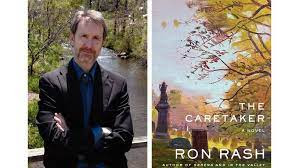
Ron Rash: The Caretaker


As close as I follow book news, I am rarely surprised when one of my favorite writers publishes a new book. I had been disappointed when I checked to see if Ron Rash would be appearing at the Southern Festival of Books in Nashville in October and did not see his name. 

Then I had a message from a friend and former teaching colleague, telling me to be sure to read his latest novel, The Caretaker. I didn't hesitate. 

I have read everything Rash has written--full-length fiction, short stories, and poetry, since his novel One Foot in Eden won the Novella prize at the Charlotte festival. Though there is often a darkness in his stories, it is never gratuitously so.  He also has the power to evoke some of the most memorable images of anyone I have read.

My students always responded to the stories in his collection Burning Bright. A favorite former student who discovered a love for reading after graduating high school read Saints at the River and The World Made Straight, then contacted me to say thanks for the recommendation.

This new novel by Rash is set during the Korean conflict, set in part on the battlefield, but primarily in Blowing Rock, North Carolina. Blackburn Gant, the caretaker at the local cemetery, is semi-reclusive after his facial disfigurement, a result of polio, makes his the victim of stares at best and mockery from some of his more cruel peers. 

Initially, Jacob Hampton appears to be the protagonist. He disappoints his parents first by choosing to work in his father's mill rather than attend college. Then, against their wishes, he marries 16-year-old Naomi, who came from Tennessee for work in the Blowing Rock Inn instead of the local girl everyone expected him to marry.

Rash's artful plot timing keeps suspense throughout the novel. He also keeps his characters' integrity (or the lack thereof) consistent through the story, even when readers might expect a sharp plot twist. As I finished, I felt satisfied that Rash had been true to the people he created.


Share/Save/Bookmark

Sunday, September 27, 2020


 “Write what you know” is a bit of writing advice that Ron Rash follows consistently. Whether in modern day or during the Civil War, his novels, stories, and poetry are set in the mountains and foothills of Western North Carolina. 

In his latest book, In the Valley, a collection of short stories and a novella, he opens with a story set near the scene of the Shelton Laurel incident, where tensions between Unionist and Confederate sympathizers came to a head with the killing of thirteen Union sympathizers, one a young boy. Rash explored these dark pages of history in his novel The World Made Straight and returns to the rural landscape in “Neighbors.” In this story, a widow is confronted by soldiers purportedly hunting for men loyal to the union, while taking scarce food and livestock. Dependent on neighbors for survival, Rebecca, the protagonist, must keep her late husband’s loyalties secret to avoid jeopardizing herself and her young children.


“When All the Stars Fell,” set in more modern hard times, shows a son in a caught in a dilemma between his father’s unswerving integrity and his own need to get even with what he sees as just one more wealthy, powerful man taking advantage of their family construction business because he can.


Several of Rash’s protagonists are measuring others’ sorrows and losses against their own. The narrator of “Sad Man in the Sky” a helicopter pilot taking tourists to view the changing colors in the mountains, bends the rules to let a broken man rain down gifts on his former stepchildren, unearthing memories of his own service in the Vietnam War. 


Jake, a Brevard art professor, in “L’homme Blessé,” is still reeling from his young wife’s sudden death a year earlier when Shelby Tate, a former student, asks to show him the primitive paintings with which her late great uncle covered his walls after returning from the service in Europe in the mid-40s.When  Jake recognizes the strange animal images from photographs of the Pech Merle cave in France, he goes with Shelby to visit an old man who had served in the war with her uncle to solve the mystery.


In small towns just off I-40, Rash peoples his stories with the broken, the lawless, people caught between good and evil, between helping others or looking the other way. While his stories all have a darkness, they give a glimmer, sometimes just a hint of light. Often the stories end without clear resolution, letting readers imagine what the characters might find just down around the corner.


Opening the pages of In the Valley, Rash’s fans have to fight the temptation to turn to the end of the book to reach the title novella “In the Valley, “a shorter sequel to Serena, his novel from 2008. The title character Serena Pemberton returns to the timberlands she has left for clearing as the deadline for the project completion nears. Many of the characters from the novel—the ones that survived—return for this narrative. In this tale, less a retelling of Macbeth this time, but no less Shakespearean, Rash’s timbermen are forced to work at a deadly pace, with too little food or rest. Serena’s henchman Galloway and his blind mother, with her evil gift of second sense, doom any who oppose Serena or try to escape her reach. Aware that Rachel Harmon and her child Jacob, the illegitimate son of Serena’s late husband, may not have put enough distance between themselves and the amoral timber baroness, Ross, a minor character in the early novel, sees his options narrow.


While the novella, like the earlier novel, lacks stereotypical heroes and antagonists, Rash leaves no question about the true villains and victims in his story.


One of the perennial favorites at Nashville's Southern Festival of Books, Rash will appear in this year's virtual festival.


Share/Save/Bookmark

Friday, July 17, 2020

Virtual Format for Southern Festival of Books Reaches Broader Audience


This is such a season of misgivings. The only reason my calendar isn't bare is that I had already recorded all the plans I had before all the cancellations--MerleFest, James Taylor and Jackson Brown at Bridgestone, Americana Fest, Swannanoa Gathering, the IBMA's, even Sing-along Sound of Music at the Nashville Symphony: Cancelled or Postponed.

This week, though, Humanities Tennessee hosted the reveal party for Nashville's annual Southern Festival of Books on Zoom. Some of the authors who will participate in the virtual festival October 1-11 were on hand to read or speak to the nearly 200 people who logged on for the virtual event. Cinelle Barnes introduced A Measure of Belonging, an anthology of new writers of color, with Nashville's own Tiana Clark reading from her essay in the collection. 

Another favorite Nashville writer Ruta Sepetys, whose latest novel Fountains of Silence is a crossover bestseller appeals to adult and young adult readers, participated, noting that she is thankful  she won't have a conflict this year--no matter where she is.  

Poet Nikky Finney also joined the meeting from South Carolina to talk about her new book Love Child's Hotbed of Occasional Poetry, with other material, including photos and notes from her years of journals, joining her poetry. 

Some favorite authors are returning: Yaa Gyassi will discuss her novel Transcendent Kingdom, due out in September. Erik Larsen will be discussing The Splendid and the Vile. Alice Randall will be reading from Black Bottom Saints. The charming and funny Southern writer Lee Smith will return to talk about Blue Marlin.

Ron Rash, a perennial favorite at the festival, has a new novel In the Valley coming out soon, which he will be discussing this year. The current National Poet Laureate Joy Harjo will participate, as will 2012 Poet Laureate Natasha Tretheway. 

One of the most engaging writers on the Zoom meeting, M. O. Walsh, author of My Sunshine Away has a new novel that is already getting advance attention. Dedicated to the late John Prine, the book also gets its title The Big Door Prize from Prine's song "In Spite of Ourselves," which Walsh said he and his wife chose as their wedding song. 

While a virtual Southern Festival of Books may be a letdown to regular attendees and volunteers who invariably go home with armloads of new books--signed by the authors, Parnassus Books has promised to do their part to make the festival a success in the new format.Other good news is that book lovers who might not be able to get to Nashville for the festival otherwise will have access now, and as the directors reminded everyone, the festival is always free. That's just one more reason to mark the first days of October 2020 on the calendar--in ink.


Share/Save/Bookmark

Friday, October 13, 2017

How to Work a Book Festival 101

No one who knows me is surprised to see how worked up I get when a book festival comes to town. One bonus of living in Nashville, then, is the 29th Annual Southern Festival of Books, which kicked off today in downtown Nashville with sessions in the lovely Nashville Public Library and all kinds of vendors with books and book-related merchandise on the plaza, along with tents set up for book signings and for musical artists.

I plot my way through a book event in a method similar to my old junior high reading habits, when I would find one another and then read everything I could find that he or she wrote. I might not be able to judge a book by its cover, but by its author, more likely.

So when I arrived today, I went to hear Jennifer Egan reading from her new book Manhattan Beach because I had loved her book A Visit with the Goon Squad, and I heard Beth Ann Fennelly discussing and reading from Heating and Cooling: 52 Micro-Memoirs because I liked Tilted World, the novel she wrote with her husband novelist Tom Franklin.

Denise Kiernan discussed The Last Castle, the story behind Asheville's Biltmore House; she had been our visit writer at Caldwell Community College's Writers Symposium discussing The Girls of Atomic City, so I knew I'd enjoy hearing her again. I wanted to hear Rodney Jones, whom I had seen first at University of North Alabama back when I was working on my master's.

Tomorrow, my plan is similar: I want to hear Wiley Cash talk about his new book because I liked A Land More Kind Than Home and The Dark Road to Mercy--and because I had liked him when I'd heard him read or talk before.  Likewise, I want to hear Gabrielle Zevin talking about Young Jane Young because I loved The Storied Life of AJ Fikry, but I may have to miss her to hear one of my all-time favorite writers, North Carolina's Ron Rash. Of course, I also want to hear Radney Foster and Peter Cooper, even though I've been lucky enough to hear them both discuss their newest books here in Nashville. I see Robert Olmsted is on a panel discussing Western Novels, and his Coal Black Horse was one of my favorites when I read it. Nicole Krauss' The History of Love was moving and haunting, so I am eager to find about her newest book.

I can't wait until Sunday, when Clyde Egerton will be celebrating "Twenty-Five Years of Raney and Floatplane Notebooks. I have a shelf full of his books, well-read, often shared.

Along the way, I'll run into my reading friends--people I know from teaching together or from book club or church, kindred spirits, and they'll tell me about a great session they've seen--that I missed.
Share/Save/Bookmark

Wednesday, October 26, 2016

Ron Rash: The Risen

I have favorite novelists, favorite poets, favorite short story authors. Then there's Ron Rash, who manages to excel at all three forms. A colleague recommended his first novel One Foot in Eden, right after it was given Charlotte's Novella Award. Then I heard him read from  Eureka Mills, one of his poetry books, at the local college, and he brought his skillful way with words to his poems.

Since then, I've had the chance to hear him read and talk about his craft in a number of events. What I learned was, first, that he exercises the kind of writing discipline that results in finished writing projects. He can talk about writing, adjusting to his audiences smoothly, addressing his readers warmly, but one gets the sense that he'd rather be writing.

I've enjoyed sharing his short stories with my community college students, many of whom recognize some of their own experiences and their own families in his stories set in the western Carolinas.

Rash's latest novel The Risen moves back and forth between 1969 and present in the life of his troubled protagonist Eugene Matney. As a sixteen-year-old, he and his brother Bill meet a bewitching girl who has been sent from Florida to live with relatives after getting into trouble back home. She introduces both boys to temptations and then leaves, presumably running away to join her friends near the beach.

While Bill goes on the a successful law career and marriage, Eugene pursues a writing career, but is cut off from his own daughter as he struggles with alcoholism. During her stay in the mountains, the girl Ligeia drives a wedge of secrecy between the two brothers; the discovery of her body forty-six years later raises even more troubling questions.

In his dark, bewitching style, Rash has developed a protagonist at once distant and sympathetic, scarred by  family secrets.
Share/Save/Bookmark

Sunday, September 13, 2015

Ron Rash: Above the Waterfall

I was introduced to Ron Rash's work first when his novel One Foot in Eden was selected for an award at the Novella Festival that was held for several years in Charlotte. A teaching colleague passed the book along to me, but it took me awhile to get around to reading it then. Once I did, though, I sought his other books and discovered not only novels but short stories and poetry.

I had the opportunity to meet Rash at the North Carolina English Teachers Association fall conference the year he was given the group's Ragan-Rubin award, and then again when he was our featured writer at the Laurette LePrevost Writers Symposium at Caldwell Community College.

Rash's writing struck a chord in my students; many of them recognized some of the conflicts the characters faced--families who weren't so happy that they were going to college to better themselves, the growing plague of meth in this part of the state. When he appeared on campus for the readings, he was warm and generous with his time. He varied his presentations, reading his audiences well. In his spare time between readings, he went back to his room to write.

Ron Rash doesn't write books so he can make appearances. He writes, it seems, because he's a writer. He has a reputation for daily discipline--and the work pays off.  While some writers are pulled away from producing more good writing after they have one successful book, relishing the book signings and readings, Rash manages to stay in control.

His latest novel Above the Waterfall, set in the part of the South near my home, brings to mind his short story "Back of Beyond," which appeared in his collection Burning Bright. While that story focused on a pawn shop owner, the plot of this book is shared by two protagonists: Les, who at fifty-one is about to retire from his job as sheriff, and Becky, a park ranger who bears serious emotional scars from her past.

The shift between narrators showcases Rash's deft use of language. Becky's sections are often poetic; in some chapters, she works on fragments on her own poetry in response to her natural world, while in others she is drawn again and again to Hopkins.

Les is a complex character--a tough guy and an artist, a lawman who accepts bribes from the area pot growers in order to focus on the local meth problem.

Both of the characters deal with guilt and trauma from their past: Becky survived a school shooting, which left her silent for a time; Les feels responsibility for his ex-wife's suicide attempt. What they hold in common is determination not to rush to judgment when an elderly curmudgeon seems the obvious guilty party when a fish kill occurs on the resort property adjoining his land. The attempt to solve the crime drives the plot, even as the novel remains character-centered.

Without sermonizing, Rash sustains an underlying theme of mercy and second chances, set against a backdrop illustrating the far-reaching consequences of the current meth epidemic on individuals, families, and communities.

Turning the last page, I could not resist going back to re-read page one, a sure sign this book will stay with me for a long time.
Share/Save/Bookmark