Thursday, January 29, 2015

Book Club (Eventually) Discusses Americanah.


When we moved states twenty years ago, I knew that certain relationship were crucial.  I consider finding a good hair stylist more important than a good Ob/Gyn, for instance. My realtor became my first friend in North Carolina (and has continued as such).  She steered me to the right eye doctor too.  I had a few missteps (my own fault) before I ended up with a good dentist (one who actually practice that medical dictum, "First do no harm.)


I realize now that if I were to leave here, I would have to find a new book club.  I've been a party of this particular book club for years now, and while the membership is always in flux, a couple of friends and I have been constants. We are different ages at different stages of life--some with pre-school children and others with grandchildren.  What we have in common is enjoyment of the social aspects of reading:  book talk.

The most difficult part of our particular group is that, while we try to maintain a consistent schedule, out lives don't lend themselves to regularity.  We chose Adichie's novel Americanah in November (for discussion in December) after I attended a particular interesting and rousing session at the North Carolina Writers Network Conference in Charlotte in the fall.

(Though Adichie herself wasn't responsible, the session became particularly memorable when one man in the back rudely tried to make the speaker move along when she was responding to another attendee's questions.  His time was obviously more valuable than anyone else's. The presenter gracefully cut him off. He left in a huff, and after a pregnant pause, the folks remaining in the room applauded the presenter. But I digress.)

Because of the hectic holiday season, we didn't actually meet to discuss the book until this week. Those of us who had read the book (and we all know some folks never quite finish) had to review before our discussion.  I see this as a problem occasionally in my own classroom. The eager beaver students who read the supplementary novel on the syllabus the first week are far removed from that reading by the time we get to our class discussion.  That's why I always recommend (1. keeping notes in some kind of reading journal--or all over the book, my personal preference); (2. brush up before the discussion date.

We had all done a little brushing up, although we often referred to the boyfriends of Ifemelu, the female protagonist, as "the rich white guy" or the African-American professor.  All of us, though, were interested in the way Adichie, Nigerian herself, like her two main characters, dealt directly with issues of race in the United States--from the perspective of an Non-American Black.

Sometimes I am put off by plot devices--diary entries, letters--particulary when they are used inconsistently through a text.  However, Adichie's device--Ifemelu's entries from her highly successful blog--are used brilliantly.  She also manages to move back and forth, not only between present (as Ifemelu prepares to return to Nigeria after time in Princeton) and past but also between Ifemelu and her first love Obinze (whom she calls "Ceiling," a private joke between the two.)

The most gut-wrenching part of the tale occurs when Obinze gets to England (instead of American, the destination for which he longs) but overstays his visa.  The frustration builds as he tries to find work and to evade deportation, with all those purporting to help him taking advantage of him and extorting money from him.

Adichie left me uncertain how Obinze eventually achieves success in his homeland, but throughout the novel, she implies that most wealth comes through help at high level and that it can be lost without warning, evidenced by Ifemelu's aunt who loses her home and lifestyle upon the death of "the General," the married man,  who has supported her and fathers her son Dike.  While the ending of the novel would play well at the cinema, I didn't find it as satisfying or tidy as it might appear--but in that way, Adichie provides much for discussion at book club!

Share/Save/Bookmark

Wednesday, January 21, 2015

Those Wacky Stories of Mismatched Love

 Nothing tests the old cliche "Opposites attract" like a story of the search for love (see The Rosie Project)--unless it's a story of love gone awry.  Several of the novels I've read in recent days or months take the romantic comedy approach to plot: Take one geeky scientist and introduce him to a knockout gorgeous artist--fireworks with the potential explosion OR fizzle.

In The Rosie Project, Graeme Simsion (scientist-turned author-turned TED talker) produced a tender, laugh-out-loud love story charming enough that more than one fellow reader I know pre-ordered the sequel just out, The Rosie Effect.  We do love to see love work out.
In I Am Having So Much Fun Here Without You, Courtney Maum reverses the formula, starting with a British artist (male) who falls in love and marries a beautiful French woman--then  when parenthood cools the relationship, he cheats--quite clumsily.  The plot, during which he is banished by his wife, who goes to her parents' home, send Richard back home to England, where he strikes up an unlikely friendship with a happily married stranger he meets in transit and then spends time observing the lovely, lasting marriage of his own parents.  Along the way, he find artistic direction, breaking out of the commercially successful but unfulfilling body of work he has been producing--his "keyhole paintings" to direct his efforts toward work with more political umph--while plotting to win back his wife.

David Nicholls' current bestseller Us opens with a family about to take the Grand Tour of Europe upon their son's graduation from high school, just as the wife Connie--an artist who has turned her back on her own work to do museum education--tells her scientist nerd husband that she doesn't think their marriage is working.  But she still wants to take the European trip.

Moving back and forth between the past and present, Nicholls reveals how this unlikely pair ended up together and explores Douglas Peterson's troubling relationship with their son Albie, a sullen boy who never actually wanted to take the trip at all.  Again, the story focuses on Douglas's attempt to repair the damage he realizes he has caused--launching him into an almost impossible mission.

All three books--and many like them--leave me rooting for the protagonist, generally a great bumbler, just hoping to capitalize on the fortunate luck that might lead to love or else recapture what led to it in the first place.

Share/Save/Bookmark

Thursday, January 8, 2015

I Am a Town: Shari Smith Strikes a Chord

While I spend a lot of time reading literature set in faraway places and long ago times, something feels right when I read a book that takes me to a familiar place. Shari Smith's memoir I Am a Town from River's Edge Media is a collection of stories that intertwine her own life with those of the good people (and even some not-so-good) in Claremont, North Carolina, her adopted hometown for many years.

Since I have lived just a few miles from Claremont--first in Granite Falls and then Hickory--for twenty years now, reading the book felt like memory, even though she's writing about her life and her people, not mine.  I'll admit, sometimes as she names names, they are my people too, especially when she mentions some of the local musicians--Reggie and Ryan Harris, Jaret Carter, Michael Reno Harrell.  The other characters, though, feel like people I know, have known.These are the people you meet in a small town if you take the time to sit down and listen.
Smith has done just that; she's paid attention to everyone from the Police Chief to man at the grill and the one-at-a-time-thank-you town drunk.

When I teach composition and literature, I like to talk about writing style.  Students understand music style and clothing style. They sometimes have a harder time understanding writing style, so I like to highlight certain writers.  Along with the obvious classics, I like to share writing by Tim O'Brien (the writer, not the musician), David Sedaris, and others who have a distinct voice.  Reading Shari Smith's writing feels like listening to her talking. Her diction, her knack for details rings true.

She opens the book by recalling the day fire destroyed the house she loved, turning her focus to all the people of the town who came to help, to comfort.  Chapter by chapter, she brings individuals to life--the boys at the back table at the cafe, the owner, the cook who talks to no one but her, Rev. Col. Russell Boggs of St. Mark's Lutheran Church, who insisted Smith speak at his funeral, read something from To Kill a Mockingbird and be funny.

I Am a Town kept hitting almost all my buttons.  I didn't think anyone else loved Harper Lee's one perfect novel as much as I did; I may have met my match.  Her enthusiasm that brought Rick Bragg to town to help raise money for a library were so familiar too. The clever, sometimes veiled allusions to books and music felt almost like a puzzle.  Not only is the title a song reference, but many of the titles are as well: "Carolina Girl," "Money for Nothin'," "The People You Meet They All Seem to Know You, "The Speed of the Sound of Loneliness."

Smith manages to invite readers into her life, introducing them to her son, her grown daughter and her family, her home and barn, to good dogs, great neighbors.  She made me laugh out loud as she described the two Lutheran Churches on the same street with competing nativity scenes, and then she made me cry when she told about her son Walker and his friends getting up from a televised Tar Heels basketball game, washing the blue paint off their face to say goodbye to a friend who lived years longer than doctors predicted.

Through the book, she makes no bones about her own beliefs and opinions, while treating those who disagree with more than tolerance, with respect and love. I wanted to stop reading, call my dad, and read aloud the chapter about guns.  In fact, I had different chapters earmarked for different friends; I knew plenty of people I am telling, will tell to read this book. Read it right now.
Share/Save/Bookmark

Thursday, January 1, 2015

It's Time for my 2014 Reading List


I am not sure how many years I have posted my list of books read in the prior year on New Years Day.  I've kept the list in my little notebook much longer.  I read awhile back that Art Garfunkel, a prolific reader himself, has kept a list of the books he's read since he was sixteen. I wish I had done the same. In fact, this year, along with books (and book gift cards), I gave my granddaughter Avery--about to turn nine--a little notebook where she can record what she reads.

 The record, which I maintain on my wall calendar, tells me much about my years.  I read fewer books in January and February as a new school semester begins.  My best reading month this year was May, particularly since I left town the morning after graduation ceremonies and headed to Dog Island, Florida, where no television or internet competed with books, allowing me to slough off the old school year.

I notice that I read quite a variety, lots of poetry (probably more than I've listed here) and more nonfiction that I once read.  My reading has taken me all over the world and back in time. I've laughed out loud (a lot) and cried just a little.  I've stopped in the middle of a page to call or email someone I think should be reading the same book.  I can't even wait to finish to be sure.  The one I'm reading right now, Shari Smith's I Am a Town, is just that kind of book. I have specific chapters earmarked for different people.

When people ask for book suggestions, my answers vary according to the asker. Some books I know one friend will love, while it would leave other reading friends untouched. Right now I'm assembling piles to passel out (part of my plan for cleaning out the study). I can't usually give my books away, but I can send them on long journeys. I'll have much to say later about my Christmas gift books (every one perfect choices) and my other to-read list. For now, here's my list. I'd love to see yours too.

Seventy Books I Read in 2014:

Robert Swartwood, ed. Hint Fiction
Louise Erdrich, The Round House
Curtis Sittenfeld, Sisterland
Wiley Cash, The Dark Road of Mercy
Alan Bradley, The Dead in Their Vaulted Arches
Amy Tan, Valley of Amazement
Alison Kemper, Donna of the Dead
Joseph Bathanti, Concertina
Fannie Flagg, The All-Girls Filling Station Reunion
Rainbow Rowell, Fangirl
Sue Monk Kidd, The Invention of Wings
Graeme Simsion, The Rosie Project
Louise Shivers, Here to Get My Baby out of Jail
Joyce Meyer Hostettler, Blue
Francine Rivers, Redeeming Love
Emma Donoghue, Frog Music
Anna Quindlen Still Life with Bread Crumbs
Christine Baker Kline, The Orphan Train
Elizabeth Blackwell, While Beauty Slept
Frances Mayes, Under Magnolia
Vivienne Schiffer, Camp Nine
Laurie Kolp, Upon the Blue Couch
Gabrielle Zevin, The Storied Life of AJ Fikry
Pat Conroy, The Death of Santini
Herman Koch, The Dinner
Michael Beadle, Invitation
Tom Franklin and Beth Ann Fennelly, The Tilted World
Gabrielle Zevin, Elsewhere
Neil Gaiman, The Ocean at the End of the Lane
E. Lockhart, We Were Liars
Robert M. Edsel, The Monuments Men
Piper Kerman, Orange Is the New Black
Joe Formichella, ed. The Shoe Burnin’: A Collection of Southern Soul
Lily Koppel, The Astronauts’ Wives Club
Dianne Setterfield, Bellman and Black
Jane Hertenstein, Freeze Frame
Sherman Alexie, Lone Ranger and Tonto Fistfight in Heaven
Suzanne Hudson, All the Way to Memphis
Ilene Beckerman, Love, Loss, and What I Wore
Peter Heller, The Painter
Justin Go, The Steady Running of the Hour
David Radavich, The Countries We Live In
Courtey Maum, I Am Having So Much Fun Here Without You
Joe Formichella, Waffle House Rules
Rachel Joyce, Perfect
Kathryn Ma, The Year She Left Us
Stephen King, Mr. Mercedes
Jill McCorkle, Life After Life
Anthony Doerr, All the Light We Cannot See
Robert Galbraith, The Cuckoo’s Calling
Judith Richards, Thelonius Rising
Rainbow Rowell, Landline
Robert Galbraith, The Silkworm
Smith Henderson, Fourth of July Creek
JoJo Moyes, One Plus One
Joe Queenan, One for the Books
Bill O’Reilly, Killing Lincoln
Adam Pick, The Patient’s Guide to Heart Valve Surgery
Liane Moriarty, The Husband’s Secret
Yvonne Wakefield, Suitcase Filled with Nails: Lessons Learned Teaching Art in 
    Kuwait
Alison Kemper, Dead over Heels
Haruki Murakami, Colorless Tsukuru Tazaki and His Years of Pilgrimage
Tom Perotta, The Leftovers
Joseph Mills, This Miraculous Turning
Liane Moriarty, Big Little Lies
Scott Owens, To
Peg Bresnahan, In a Country None of Us Calls Home
Michael McFee, The Smallest Talk
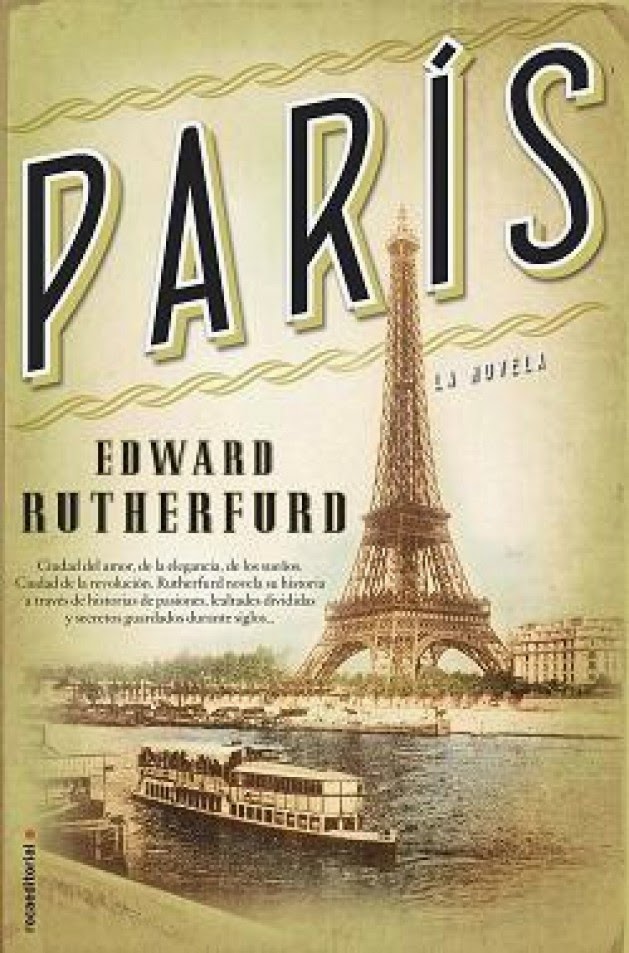
Edward Rutherford, Paris
Chimamanda Ngozi Adichie, Americanah

If you're still with me, you may find an imbedded link to the IndieBound Next List, my not-so-subtle hint that you support independent booksellers.

Share/Save/Bookmark

Friday, December 26, 2014

Paris over the Centuries

Sometimes when I'm picking an audiobook to play on my drive back and forth to work, I find myself gravitating away from any title with too many discs, especially since I get most from the public library. I remind myself of students who, when picking a book for an assignment, go for the shortest--often a mistake.

During December, though, I picked up Edward Rutherford's Paris.  I have intended to read other books of his--London or Sarum.  He had, after all, come highly recommended, and I always loved a good epic-style story spanning centuries in one place.  This book fit the bill perfectly.

Once I got started, I wondered what had taken me so long. This book stays in Paris, following several families back and forth between the Middle Ages and post-World War II.  Rutherford has an aristocratic family crossing paths with a family of wealthy merchants, a working class family, a Jewish family, and another family on the edge between legal and illegal activity.  The storyline studies the roles of class and religion, always complicated, often changing.

Since I teach British literature, I feel relatively knowledgeable about that part of history, but this book helped me to fill in the blanks of French history--even European history in general.  Instead of following a purely chronological order, Rutherford moves back and forth between centuries, with the family names as constant threads.

Having traveled to Paris and other parts of France with students twice several years ago, I especially loved revisiting places I had visited.  The characters visit Sainte Chappelle, one of the loveliest spots in the city, a jewel box of a church, once reputed to display many holy relics. As they moved through Versailles, the Louvre, along the Conciergerie, along the Champs Elysees, I felt as if I were time traveling.

In one of my favorite story threads, one of the young men in the story works first on the Statue of Liberty, then on the building of the Eiffel Tower.  Along the way, I learned so much history--without ever feeling as if I were being taken to high school.  These stories were alive with the human beings that lived them--not just dates and place names. I had no idea, for example, that when Hitler came to Paris, he had wanted to go to the top of the tower, but the elevator cables had mysteriously been cut.  Rutherford takes his poetic liberties here as he places fictional characters against his historical backdrop.

Reading Paris reminded me why I had once loved all of Michener's books and the historical novels by Follett.  Now I need to take my copy of London off my shelf. As soon as I get through my Christmas gift books.
Share/Save/Bookmark

Sunday, December 14, 2014

Christmas Stories Worth Reading--Again and Again


Christmas vacation may not allow even a sliver of the reading time afforded by summer vacation, but so many people I encounter look forward to the possibility of a little time to read, amid all the shopping and other turmoil of the holidays.  My holiday traditions include some Christmas stories to which I return again, usually pushing them onto my friends and family as well.

I was first introduced to Truman Capote's lovely short story "A Christmas Memory" when I was student teaching, and I've read it every holiday since. Usually, I find some way to share it with my students too.  Anyone who loves Harper Lee's  To Kill a Mockingbird has to love this story too.  It's so easy to picture the story taking place in a town like Maycomb, Alabama. I   picture Buddy, the narrator, as Dill--not the actor who played him in the movie--but the Dill inside my head.  

Few stories strike all five senses the way this one does--the scent of the tree, the icy cold water through which they wade, pushing the rickety old baby buggy, the copper smell of pennies as they count the fruitcake money.  I still can't get through the final scene in a faraway November without a lump in my throat.

Not all my favorite Christmas stories are tender and touching.  For years, I have gotten a perverse kick out of "The Gift of the Magi Indian Giver" from an early collection by Steve Martin, Cruel Shoes.

No Christmas would be complete without David Sedaris' "SantaLand Diaries," just one of his hilarious pieces in Holidays on Ice.  The first time I read the story, I was administering a semester exam, and I laughed so hard I disturbed the students during their testing. The only thing that rivals reading this story is listening to Sedaris reading it himself.  Nonetheless, he is such a master of tone that I hear his voice when I read anything he writes.  When "Santa Santa" insists that elf David sing "Away in a Manger," he channels Billie Holiday and belts it out. 

Since I always love those stories told from another point of view, Tom Mula's Jacob Marley's Christmas Carol, the story of Marley's redemption after returning to warn his old partner Scrooge, has been a favorite too.

This year I'm looking forward to reading the rest of Joseph Bathanti's new collections of essays Half of What I Say Is Meaningless after he read from it an account of being asked to read a Christmas story to children at the public library early in his marriage, using the poor judgment of reading a story he hadn't previewed, Hans Christian Andersen's "The Little Fir Tree."  As is true of most live Christmas trees, the story does not end well.

I'm eager to see which story finds me this year.  I don't have much time left to find it, but I hope it will be one I want to read again and again.

Share/Save/Bookmark

Monday, December 8, 2014

R.I.P. Kent Haruf

Too often these days, when I go online I find that another favorite author or poet has died.  Today, before I had time to wake up completely, I saw a message that Kent Haruf had died.

I discovered Haruf almost by accident. I hadn't heard any mention of his novels--I thought--but I picked up the audiobook of Eventide for listening as I commuted to work.  The story was so simple, so subtle, I was almost underwhelmed at first.

Then something happened in the story--no spoilers here--and I found myself driving down the road sobbing.  Most people who know me can attest to the fact that I am not much of a crier.  Tender heart. Dry eyes.  In this story, though, something happened to a character that touched me most because of the effect on another character.  Only after I finished this lovely book did I find that it was the sequel to Plainsong.  Both books center around a young girl who becomes a single mother, but the characters I loved the most were two brothers--both single--who worked together on their farm.  At the request of a local teacher, they took in this girl whose family had thrown her out, and they cared for her until her baby was born, even though they had no experience at all.

In the second book Eventide, the young girl goes to college, taking her child with her, but maintains a relationship with these two gentle men. Haruf brings readers into Holt, Colorado, and introduces them to the ordinary but unforgettable citizens who live there. 

In his last novel Benediction, set in the same town, the characters of these two books appear in the background.  I felt a bittersweet pang of remembrance at each mention.  Now I feel a strong urge to look for his other works, just to be sure I haven't missed a gem.

In the meantime, as I'm gathering a stack of books for a friend who just returned her last stack I lent her by mail, I know I'll have to be sure to include Plainsong. It's one of those rare books I feel comfortable recommending to all of my reading friends.
Share/Save/Bookmark