In a totally different vein, I enjoyed Carole King's memoir A Natural Woman, which follows her life, tracing her success as a songwriter and singer, as well as detailing her personal life. I am always shocked to be reminded just how young she and Gerry Goffin were when they began penning their mega-hits. Rather than a tell-all in which she spills the dirt on others whose paths crossed her, this book is usually generous to other she knew but sometimes painfully honest about her own life choices. Details of her performance as part of James Taylor's band was a stunning reminder of all the talented musical arts who supported one another during their heyday. The book begs for a companion playlist. Michelle Zauner's memoir Crying in H Mart, which began as a New Yorker essay explores the complicated dynamics between mother and daughter, compounded by culture. Zauner, the Korean-American lead singer of the indie rockers, Japanese Breakfast, particularly explores the strong sensory connection between familial ties and food. For book clubs that pair meals with books, this memoir provides a perfect culinary opportunity. After reading Lisa See's Island of the Sea Women and The Girl with Seven Names by Lee Hyena-seo, one fiction and the other non-fiction, I am beginning to crave kimchi.
Thursday, May 26, 2022
Nonfiction Choices of the Summer Reading List
In a totally different vein, I enjoyed Carole King's memoir A Natural Woman, which follows her life, tracing her success as a songwriter and singer, as well as detailing her personal life. I am always shocked to be reminded just how young she and Gerry Goffin were when they began penning their mega-hits. Rather than a tell-all in which she spills the dirt on others whose paths crossed her, this book is usually generous to other she knew but sometimes painfully honest about her own life choices. Details of her performance as part of James Taylor's band was a stunning reminder of all the talented musical arts who supported one another during their heyday. The book begs for a companion playlist. Michelle Zauner's memoir Crying in H Mart, which began as a New Yorker essay explores the complicated dynamics between mother and daughter, compounded by culture. Zauner, the Korean-American lead singer of the indie rockers, Japanese Breakfast, particularly explores the strong sensory connection between familial ties and food. For book clubs that pair meals with books, this memoir provides a perfect culinary opportunity. After reading Lisa See's Island of the Sea Women and The Girl with Seven Names by Lee Hyena-seo, one fiction and the other non-fiction, I am beginning to crave kimchi.
Friday, August 13, 2021
Mixing in Some Nonfiction
I know my reading choices throw the algorithms of all those sites trying to sell me books. I'm amused that because I bought a particular textbook (Surpassing Shanghai), I am suddenly inundated by books and articles related to education in China--a month after the course ended. Of course, six years later, Pinterest is still sending me moving tips (No thank you!). I don't need their suggestions for rehearsal dinners either.
Even when the book suggestions align with my reading tastes, they come along too late. I read through saying, "Yep! I've read that one...and that one....."
All summer, I've worked some nonfiction into my fiction mix. After the aforementioned course (Comparative International Education), I re-read With Rigor for All by Carol Jago (from Heinemann Publishers). It is the best kind of publication aimed at educators: one that can immediately put to use in the classroom. I have long known Carol from all the years I attended the annual convention of the National Council of Teachers of English. She writes based on her experience "in the trenches," teaching high school English. By the way, she is also a voracious reader whose lists I seek out. In this book, one of the main points is that when schools teach challenging literature only to the "top students," while others are assigned books they can easily read on their own, the gap gets wider. Rather than stopping with a theoretical claim, she shares strategies for guiding all students through these texts.
Another favorite book I've discovered this summer is Electric City by Thomas Hager. The main story, set near my North Alabama home, is one with which I have been long familiar: Henry Ford's failed plans to build a 75-mile city along the Tennessee River, where agriculture and manufacturing would coexist in a way to benefit the many workers who would be employed in this "new Detroit." Hagar discovered the story and found an appreciation for the people of the Muscle Shoals area during a visit where he discussed a book he had written about fertilizer. (No, I haven't read that one.) His interest was piqued and he completed the research for this fascinating book.
If you checked in for some fiction recommendations, hang on. I'll have those soon too.
Mixing in Some Nonfiction
Thursday, January 4, 2018
My Favorite Nonfiction in 2017
Monday, January 1, 2018
New Year Tradition: My 2017 Reading List
In the coming days, I want to give some "best of" details--novels, poetry, and nonfiction, but for now, I'll share my list. I hope some of my reading friends will reciprocate.
1. Wally Lamb, I'll Take You There
2. Jessie Burton, The Muse
3. Yaa Gyasi, Homegoing
4. Regina Calcaterra, Etched in Sand
5. Amor Towles, A Gentleman in Moscow
6. Ruth Ware, The Woman in Cabin 10
7. John Lewis, et al., The March (Book 1)
8. Lauren Wolk, Wolf Hollow
9. Julia Glass, And the Dark Sacred Night
10. C. S. Lewis, Mere Christianity
11. Paulette Jiles, News of the World
12. Ruth Reichel, Delicious
13. Kelly Demaegd, Wish and Spit (poetry)
14. Nicola Yoon, The Sun Is Also a Star
15. Marie Semple, Today Will Be Different
16. E. L. Doctorow, Andrew's Brain
17. Susan Perabo, The Fall of Lisa Bellow
18. Lauren Dave, Hello, Sunshine
19. Camron Wright, The Orphan Keeper
20. Nancy Peacock, The Life and Times of Persimmon Wilson
21. Archibald MacLeish, JB
22. J. D. Vance, Hillbilly Elegy
23. Zadie Smith, Swing Time
24. Peter Cooper, Johnny's Cash and Charley's Pride
25. Amy Greene, Long Man
26. Marie Howe, The Kingdom of Ordinary Time (poetry)
27. Tiana Clark, Equilibrium (poetry)
28. Jodi Picoult, Small Great Things
29. Diane Ackerman, The Zookeeper's Wife
30. Frank Conroy, Body and Soul
31. Bill Browder, Red Notice
32. Lisa See, The Tea Girl of Hummingbird Lane
33. Kathryn Kirkpatrick, Unaccountable Weather (poetry)
34. Cathy Smith Bower, The Candle I Hold up to See You (poetry)
35. Noah Hawley, Before the Fall
36. Lily King, Euphoria
37. John Grisham, Camino Island
38. William Kuhn, Mrs. Queen Takes the Train
39. Ron Rash, Eureka Mill (poetry)
40. Hanna Tintt, The Twelve Live of Samuel Hawley
41. Elizabeth Strout, Anything Is Possible
42. Kathleen Rooney, Lillian Boxfish Takes a Walk
43. Graeme Simsion, The Best of Adam Sharpe
44. Carl Hiassen, Razon Girl
45. Nicole Yoon, Everything, Everything
46. Christine Baker Kline, A Piece of the World
47. Colum McCann, Letter to a Young Writer
48. Stephanie Powell Watts, No One Is Coming to Save Us
49. Joy Jordan-Lake, Tangled Mercy
50. Gin Phillips, Fierce Kingdom
51. Taylor Mali, The Whetting Stone (poetry)
52. Linda Sue Park, A Long Walk to Water
53. R.J. Palacio, Wonder
54. Beth Ann Fennelly, Heating and Cooling: 52 Micro-Memoirs
55. Thomas Mullen, Last Town on Earth
56. Trevor Noah, Born a Crime
57. Anne LaMott, Hallelujah Anyway
58. Natalia Burian, Welcome to the Slipstream
59. Brian Selznick, Wonder Struck
60. Glennon Doyle Melton, Love Warrior
61. Ann Hood, The Book That Mattered Most
62. Ben Winters, Underground Airlines
63. Gabriel Zevon, Young Jane Young
64. Greg Boyle, Tattoos on the Heart
65. Celeste Ng, Little Fires Everywhere
66. Antoine de Saint-Exupery, The Little Prince
67. Jennifer Egan, Manhattan Beach
68. Joseph Bathanti, Restoring Sacred Art
Some of the books were unforgettable, while others like Chinese food didn't stick. I took the time to re-read a few I love, and I picked up a couple of older books I had been waiting to read, and I was so glad I did. Many of the choices were dictated by my book groups. As a result, I discovered some thought-provoking books I might have missed otherwise.
As the year ended, I've been reading Walter Isaacson's biography Leonardo da Vinci with only about 400 page to go), and I'm listening to Ken Follett's Column of Fire, the third in the series that started many years ago with Pillars of the Earth, on my all-time favorites list. My to-read list is long, almost overwhelming, but I'm comforted to know I could be iced in and not lack for something good to read.
May 2018 bring many good books your way.
New Year Tradition: My 2017 Reading List
Monday, October 23, 2017
Nonfiction Mode in October
While probably ninety percent of my reading is fiction, a heavy dose of novels, augmented by short stories, I venture into all the genres. In fact, when I checked the best seller lists in yesterday's New York Times Book Review supplement, I was surprised to find I'd read more of the current nonfiction list than fiction. (Admittedly a couple of the works of fiction are on my "want to read" list.)I listened to Trevor Noah's Born a Crime on audio, a good choice since he actually does the reading himself. I didn't know much about Noah, since I'm not much of a talk show viewer. Okay, since I'm not much of a television viewer. The book, though, was a selection this fall by my book club. Even though I wasn't able to make the discussion, I read it anyway. I'm still thinking about the book. He takes on some serious topics with just the right dash of humor. I'll admit that I fell in love with hi mother, despite some of her poor choices that affected her children as much as they did her.
So much of what Noah shares should be common sense--if anyone was interested in common sense. He challenges the "Give a man a fish, he'll eat for a day. Teach a man to fish and he'll eat for a lifetime," pointing out that someone may just need to give the man a fishing pole!
I knew I had some drive time ahead, so I also picked up Anne Lamott's latest book Hallelujah Anyway on CD, even though I have a print copy too. I'm glad I do because I plan to go back and re-read just so I can write down some of her memorable lines. In the book, Lamott begins with the verse from the prophet Micah in which he tells us what God requires: to act justly, to love mercy, and to walk humbly with the Lord. Her focus in the book is mercy, not only mercy from God but that we bestow on others--and ourselves. She is such an unconventional writer, living out her Christianity in unexpected ways. Her revelation about her fight against her own alcohol dependency resound with honesty.
I have used parts of her classic writing text Bird by Bird in comp classes and in my own writing. She can take something intangible and share practical steps to take, usually advice she's gleaned from others-especially counselors. I was so moved by her memories of her father's failure to respond to another man's disparagement of her hair when she was four, a encounter that shaped her self awareness. Eventually, she was advised to invite someone she considered a comforter and someone who represented strength into that memory to confront both men and to change the effect on her. It may seen a little "woo woo" but I like to think I have a battalion of supportive people who could do the same for me if I had similar bad memories that wouldn't leave.
I'm already back into fiction now (with a small dose of Car Talk stories from Click and Clack from NPR), but I'm glad I've added a dose of nonfiction to my reading brain.
Nonfiction Mode in October
Thursday, January 1, 2015
It's Time for my 2014 Reading List
If you're still with me, you may find an imbedded link to the IndieBound Next List, my not-so-subtle hint that you support independent booksellers.

It's Time for my 2014 Reading List
Thursday, June 14, 2012
History with an Individual Focus
I first discovered Erik Larson's work when I read The Devil in the White City, his book that tells of the people who dreamed of the Chicago World's Fair and brought it to life. In that book, while looking at the big picture, Larson wove a narrative thread of a doctor in town who became a serial killer, luring young women who had arrived in town, single and independent for the first time, then murdered them.
While that story was particularly disturbing, the facts and details he used to balance it, telling about the architect heading up the plans for the exposition, Buffalo Bill's performances outside the perimeter of the fair, the first Ferris Wheel, the fire--all were fascinating to me. In fact, the year I read the book, I went to Chicago with my husband on business and while he worked, I visited the Museum of Science and Industry, the only permanent building of the World's Fair, and Graceland Cemetery, known as "the architects' cemetery" to see the graves of so many people mentioned in the book.
I went on to read Thunderstruck, the story of Marconi and the invention of the telegraph, told alongside the story of Hawley Crippen--another true life murder mystery.
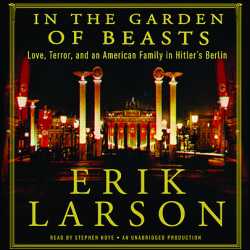
This summer, after visiting The United States Holocaust Museum in Washington, D.C., again, I began reading Larson's latest publication In the Garden of the Beasts. There have certainly been many various accounts of Hitler's Germany, but this book focuses on the early years, beginning in 1933 when William Dodd was named U.S. Ambassador to Germany. An unlikely pick, Dodd and his family spent several unsettling years in Berlin during Hitler's rise, as America and most of Europe seemed to ignore all warning signs, intent on keeping peace--or attempting to recoup the debt of Germany owed to American investors.
In this book, Larson focuses on Dodd and on his adult daughter Martha, who traveled with her father, mother, and brother, leaving behind an estranged husband about whom she told almost no one. She lived an exciting, sometime scandalous social life, consorting with men of all nationalities--including prominent Nazis--and falling in love with a Russian diplomat charged with recruiting her to spy for the Soviet Union. In the novel, Dodd is shown and often misunderstood and maligned. He was an academic placed amid the "Pretty Good Club"--diplomats living on inherited wealth, far above their salaries. Dodd insisted on shipping his old, plain Buick to Berlin and living as a model for American citizens suffering through the Depression. His example earned more ridicule than admiration.
Dodd seemed to open his eyes more quickly to Hitler as a threat, but his warnings were barely heeded. Only years after he was recalled to the States--leaving reluctantly--did other recognize his insight.
Through the stories of Martha's interactions with the people of Berlin, Larson also introduced a number of American journalists--some with Jewish heritage--working in an increasingly threatening environment.
While it seems that everything that could be written about this part of the world at this particular time has been written, Larson's book manages to serve not only as a historical account, but as a warning to readers to pay attention to the world scene, not discounting aspiring leaders with ridiculous agendas. Hitler, while seeming cartoonish and laughable, certainly inspired much more than mockery.
History with an Individual Focus