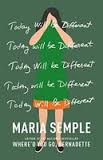
I don't have to have my literature with tidy endings, though I do love an author who can end a book in a way that satisfies, even when it surprises. Sometimes though, in literature as in life, the endings are more complicated. Two of my most recent reads have been almost unsettling in that way that keeps me thinking about them. Nevertheless, they bear almost no similarities otherwise.
Maria Semple, who wrote
Where'd You Go, Bernadette? has followed with a "one day in the life" story of Eleanor Flood, a wife and mother beginning her day making a commitment to be a better person. She's called away from her private poetry lesson when her son complains of illness--again--to the school nurse. She and her son Timby discover that her husband, whom she saw holding his head at the breakfast table, is not only not in his office but that he
has told his employees he's on a week vacation. Suspecting the worst, she and Timby engage in a series of adventures across the city. Flashbacks and stream-of-consciousness inform readers of her career writing for a popular television series, her far-too-prolonged book deal, and her estrangement from her sister, the other "Flood Girl." At times, Semple shifts to husband's Joe's point-of-view as well.
At story's end, after much "madcap adventure," she discovers
(spoiler alert) that her husband--a former Catholic and avowed atheist--has become part of a Christian congregation after the team chaplain on the sidelines where he serves as orthopedist on call begins to help him address personal problems. While at book's end Eleanor and Timby seem eager to join Joe as he goes to seminary in Scotland, she doesn't seem to make any kind of peace with his conversion. In fact, she says he has gone from being the most interesting person she knows to the most boring. That seemed problematic at least to this reader.
In
Andrew's Brain, the last novel by the late E. L. Doctorow, the entire narrative is revealed as the title character engages in a dialogue with someone he refers to only as "Doc." Through these conversations, the details of his life are teased out: After his failed marriage to Martha, following the death of their only child, he ends up appearing on Martha's doorstep bereft, holding the infant child of his second wife Briony, his much younger former student, who has apparently died. (This is not a spoiler. That much is revealed early. The full story emerges only in bits and pieces.) While Andrew may not be a totally unreliable narrator, his tendency to withhold details, even entire incidents, until he feel the time is right, keeps readers guessing before he delivers one-two punches.
I kept thinking of a favorite old Young Adult novel by Robert Cormier,
I Am the Cheese, also a tricky little tale told in much the same fashion, but with an ending that sent me immediately back to chapter one. Andrew is complicated but engaging, and his observations about people in his life are intriguing. Everything about him, though, is revealed indirectly. (As Emily Dickinson suggests, "Tell the truth but tell it slant.").
Both of these books kept me interested but left me a bit unsettled, thinking about them long after I came to the conclusion. Maybe that's not such a bad reading experience.

Books That Make Me Think about Resolution: Andrew's Brain and Today Will Be Different


 Posts
Posts