Showing posts with label Vietnam war. Show all posts

Friday, June 28, 2024

Summer Is for Reading

 Summer reading has so many connotations. While, for most adults, summer doesn't necessarily have more time for pleasure reading than any other time of the year, the idea of lazy days under a beach umbrella with a good book is still appealing. For those of who living on the academic calendar, summer means a break from boning up on required reading--and especially from reading stacks and stacks of student papers. 

My list of what I want to read next far extends the number of days and hours, but I have made a valiant effort to make the most of reading time. One of the best surprises for me so far has been Monica Wood's novel How to Read a Book, not to be confused with the nonfiction book of the same title by Mortimer Adler.)

This novel opens in a women's prison, where 23-year-old Violet Powell attends a book club while serving time. The narrative shifts perspectives between Violet, Harriet Larson, the retired English teacher who moderates the book club, and Frank Daigle, a retired machinist whose life is inextricably linked to Violet's. 

As a book clubber and English teacher, I loved Harriet's effort to find reading material that will appeal to her motley crew of woman. While the women bond over their supposed antipathy for the book selections, they are won over by poetry, particularly Edgar Lee Master's Spoon River Anthology. 

The book takes interesting turns, especially as Violet tries to start a new life "in the Outs." Wood's story affirms the power of forgiveness, friendship, and second chances. I was already recommending the story before I finished it, knowing I'd need to talk to someone about it as soon as I finished.


Wrong Place Wrong Time
by Gillian McAllister, one of the selections from Reese Witherspoon's Book Club, is a suspenseful novel that makes a perfect summer read. As the book opens, Jen Brotherhood is waiting for her 18-year-old son to get home by curfew. She sees him arrive as a man approaches. To her horror, she sees her son stab the man. She and her husband Kelly go through the nightmare of his arrest, forced to leave him in the jail cell. The next morning, she is shocked to see her son at home--until she sees on her calendar that she has over back to the prior day. 

I will admit that I am a sucker for time travel stories. In this story, Jen is moving backward, first a day at a time, and then with larger leaps. Is the butterfly effect in operation? She has to deal with the frustration of knowing that anything that happens, anything she tells anyone will have no impact as she moves backward. McAllister managed to keep me guessing through the entire story. 

I finally got to read the latest Kristin Hannah novel The Women that so many people have been talking about. To be honest, the writing is what one would expect from the romance genre--far too many coincidences, too predictable in places, and nothing so well worded I had to stop and make notes, BUT having lived through the Vietnam era and aftermath, I was interested in this story of the often overlooked women who served as military nurses in country. Frankie McGrath has grown up in wealth and comfort, but has always been haunted by the "hero's wall"--curated by her father who had not been able to serve. 

When Frankie, a trained nurse, joins the Army and volunteers for Vietnam, her parents react in shock. The description of the horrors, the friendships, even the music, the protests, and the inconsistent news reporting bring the historical period to life. Hannah has done her research. In the afterword, she says despite her interest in telling the story decades earlier, she had to wait until she was read to tell the story.
The novel is worth reading, even if only to discuss the era with others. I'm curious as to whether the recurring motifs of cheating death, chance encounters, and dishonest lovers was an obstacle to other readers. 


Share/Save/Bookmark

Friday, February 16, 2018

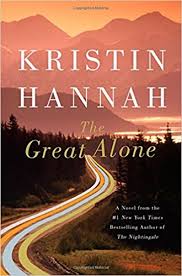
The Great Alone: Kristin Hannah's Alaskan Adventure

When I heard Kristin Hannah had a new novel, I was expecting something like The Nightingale, her last book set during World War II. Instead, she tells a story that begins in 1974 with Leni Allbright, a young girl whose father has returned a changed, broken man after released from captivity as a POW in Vietnam.

Throughout the story, I'm reminded of how much the world has changed, how much we know now that we didn't when I was a teenager. This tale is set in a world in which PTSD is still considered "shell shock"--if considered at all. Abused women have no legal defense if they take action against their abusers. DNA testing isn't an option in the event of a crime, and it's not yet possible to track down someone simply by Googling.

Leni and her mother Cora walk on eggshells around Ernt, her father, who wakes with night terrors and the slightest thing can cause him to snap violently. When a friend he lost in Vietnam leaves his cabin to Ernt and the family, the family makes the decision to move to remote Alaska. They arrive completely unprepared for life in a small town without indoor plumbing or even electricity in most places.

Leni finds herself torn when she falls for Matthew, the only boy her age in the small school and the son of the relatively wealthy family that first settled the town. Her father connects with the family of his lost friend, a branch of survivalists preparing for the inevitable showdown they refer to as WSHTF. He despises and resents Tom Walker, Matthew's father, and Cora's evident attraction adds fuel to the fire.

Hannah peoples the town with many colorful characters, a crazy man who claims to be married to his duck, and a former lawyer calling herself Large Marge, who befriends and helps the Allbright women as they learn to survive. Leni has to learn to farm and to hunt. She has to be wary of bears and other predators. She has to be wary of her father's sudden mood shifts.

As they have to work fast and hard to store up food for the long winter, Leni and her mother realize that the extended darkness will bring out the demons in Leni's father.  He becomes increasingly physically abusive toward Cora, whose toxic love keeps her from pressing charges or leaving him.

Throughout the story, the author maintains tension as the characters, even levelheaded Leni, make wrong moves with dire consequences. What develops is a love story for the wilds of Alaska, and the complicated love/hate story that many children--and adults--endure.

As in The Nightingale, Hannah sometimes tests the reader's "willing suspension of disbelief," and her heavy use of parenthetical expressions sometimes made me want to suggest that she should trust her readers to recognize the significance of these side details.

Without adding any spoilers, I must say that I wrestled with some of the plot resolution, but the narrative kept me turning pages long after time for lights out.
Share/Save/Bookmark