Friday, August 16, 2013

Partly Truth and Partly Fiction

Most people who know me know that  tend to read more fiction than nonfiction. I love story.  I also feel strongly that a work of fiction can also be true.  Truth does not equal fact.  I'll climb down off my soap box now.

Usually when I read Jodi Picoult, it's a selection by someone in my book group.  I recognize that she tackles a lot of controversial or current topics.She also tends to throw readers a curve ball at the end of most of her novels. (Excuse the mixed metaphor there.) This book, though, particularly caught my attention since I am starting this week to team teach the Holocaust class offered at the college where I work. This is either the third or fourth time I've been involved with the course.  As we plan the syllabus, inevitably the challenge is what to leave out, since there are so many books, poems, movies and more.

In this novel, she weaves a story with three interlocking lines--at least three.  The main character Sage (with sisters named Saffron and Pepper.  Seriously.) is a young single woman working the graveyard shift as a baker in order to avoid people. She has a facial scar, the result of a car accident that led to her mother's death.  Obviously, some of her scars are invisible.  At her grief group she forms a friendship with an elderly man, whom she learns was a Nazi officer during WWII.  The second story line is that of her grandmother Minka, the daughter of a baker and a survivor of Auschwitz.  She also has created a Gothic fairytale, putting her in the role of Sheherazade in the camps.

Into the mix Picoult adds the married man with whom Sage has conducted a relationship after he served as undertaker for her mother's funeral.  The unlikely hero of the story is a young agent working to locate former Nazis and bring them to justice.

At times readers may find Sage a character unlikely to elicit sympathy.  I can't say that I always liked her--or believed her.  I did want things to work out for her.  Some of the secondary characters were caricatures--one of Sage's co-workers who speaks only in haiku. (Technically, since he only adhere's to syllable count, his lines would be senryu).  Her boss is a former nun. The other members of the grief group also seem a little over the top sometime.

The best part of the story, I believe, is Minka's story. Picoult has evidently researched her topic carefully.  The young German officer, while evil, seems believable in light of historical accounts.

Picoult has a natural audience for her fiction, and in this case, she deals with a period of history that can't be ignored.  She certainly led me to investigate further a story in which I am now about to be immersed for another semester.
Share/Save/Bookmark

Thursday, August 15, 2013

A Title I Could Borrow


Awhile back, I needed to come up with a name for a word document that would not draw attention to itself.  What I chose (and I could tell you, but I'd have to kill you) isn't too far from the title of the second book I've read this summer by Jess Walter, The Financial Lives of Poets. As an English instructor with an undergraduate degree in accounting, I couldn't possibly pass up this particular novel, now could I?

I must say, first, that nothing about the plot or the characters of this novel remind me of Walters' most recent success, Beautiful Ruins (which I do believe I've discussed in an earlier post). But the writing is certainly as engaging.

In this case, his protagonist Matthew Prior goes to a 7/11 for milk (at, he claims, nine dollars a gallon) when he runs into young men who turn out to be drug dealers.  They pressure him into giving him a ride to their place (all the while, drinking right out of his jug of milk).  One thing he learns on his late night adventure is that marijuana has certainly changed from his college days.

Prior's foray out of the house at this unlikely hour, readers learn, is motivated in part by the looming disaster in his personal life. He's quit a journalism job and invests in a website offering financial advice incorporating poetry--presumably to make it more interesting.  Needless to say, the venture hasn't realized the success he'd hoped. Meanwhile, he's on the brink of losing his house--and his wife, whom he has discovered is carrying on a texting relationship at least with a former boyfriend.

The lengths he goes to try to remain solvent and to gain an advantage over his wife's old flame are quirky and hilarious. Readers are often one step ahead of Matt as his shenanigans always take the worst possible turns. To compound his misery, his father--suffering from dementia--is living with him and carrying on the same three or four conversations over and over.

Walters manages to turn what sounds like a dark and dreadful story into a genuinely funny adventure.  Interesting enough, I just learned, to lure Jack Black into a movie called Bailout, based on the novel, still listed in IMDB as "in development."  I'm looking forward to seeing what develops.


Share/Save/Bookmark

The Interestings

This summer was so packed full that when I had to choose between reading and writing about what I read, I guess I chose reading.  The little blog fiasco slowed me down a little too. As a result, I have plenty to share now that I'm back in school.

I've had Meg Wolitzer books sitting on my shelf awhile, but something about the latest, The Interestings, caught my attention.  And while you shouldn't judge a book by its cover, this one is particularly attractive.  The scenario isn't necessarily original--the lives of a disparate group of teenagers who become unlikely friends and stay close into adulthood.  In this case, the group meets in the early seventies at a camp for artsy kids. While this is something of an ensemble cast, Julie Jacobson (who become Jules her first summer) emerges as the protagonist. She ends up at the camp right after her father dies in his forties from pancreatic cancer.  A teacher manages to help her go on scholarship, and while there, she is included in a small circle of teens she would normally consider out of her league. The most charismatic of the group, Ash Fox, who attends the camp with her underachieving brother Goodman, becomes Jules best friend.

Also in the circle are Ethan Figman, already a prodigy at fifteen, an unattractive but personal boy with a talent for drawing a cartoon he calls Figland.  While he is drawn to Jules, she keeps their relationship in the friend zone.  Also in the group are Jonah Bay, the son of a famous folk singer, talented himself, but carrying a burdensome secret placed on him by one of his mother's former singing partners. Rounding out the group is Kathy Kiplinger, a talented dancer already growing into too womanly a body for a future career.

Woltizer follows the teens as they maintain their friendship between camp summers, usually meeting at the Fox's New York City home, the Labyrinth.  An incident between Goodman and Kathy ends up changing their lives and the nature of their relationships.

Wolitzer sheds light on what happens to people living in the shadow of those they perceive as having it all.  Jules and her husband--not one of the circle of Interestings--live ordinary lives, sometimes touched by depression, and often by envy, particularly of Ethan and Ash. Ironically, these two, while financially successful, have to deal with a special needs child and with several family crises.Wolitzer also deals with the effect of secrets kept from marriage partners.

While she touches on lots of current events and social issues, Wolitzer primarily focuses on human relationships, love, and trust.
Share/Save/Bookmark

Wednesday, July 24, 2013

She's Baaaaccckkkk!

This has been one of the most frustrating, tedious web adventures for me so far, but as of 1:29 a.m. on Wednesday (Is it Wednesday?), I finally have my domain name back--and working.  Many thanks to the patient gentleman who just finished troubleshooting.

I have plenty of catching up to do now, but this week I am at the Swannanoa Gathering Old Time Music and Dance Week at Warren Wilson College, so I won't be getting much reading done.  However, since I've finished eleven books in July so far, I have lots to share soon:  Jess Walter's The Financial Lives of Poets (very funny and nothing like his novel Beautiful Ruins); Jeanette Walls' The Silver Star, her first novel after her two nonfiction works, The Glass Castle and Half-Broke Horses; Peter Heller's The Dog Star (for anyone in the mood for a dark little mid-apocalyptic novel); Becoming Odyssa, Jennifer Pharr Davis' memoir of her adventures on the Appalachian Trail; The Fault in Our Stars, John Green's wonderful YA novel--and there are plenty more.  I'll keep you posted.
Share/Save/Bookmark

Thursday, July 18, 2013

...and not a minute too soon: And the Mountains Echoed.

I just got off the phone with Go Daddy, and I now have both my .com and .net domains until 2023.  (If you're still reading then and think I've lost my marbles, please take steps to stop my posting!)

For such a busy July, I have been reading voraciously (last count, ten books so far this month--and anyone who knows me knows I haven't been lying around the house!)  My selections have been completely diverse (as are the ones I'm reading now).  I must work in reverse chronological order:

I just finished Khaled Hosseini's third novel And the Mountains Echoed. So far, he's three for three, as far as I'm concerned.  The Kite Runner probably received more publicity (and the movie deal), but I thought the next one A Thousand Splendid Suns was at least as good, maybe better.

This time, I opted for audio for two reasons: (1. It was available at the library; (2. the author's reading the parts with a male narrator. Let me make that three: (3. I heard from another reading friend who'd just finished listening and loved it.  I did too.

This novel, set mainly but not exclusively in Afghanistan, covers several decades and several main characters, whose lives overlap, sometimes directly, sometimes tangentially.  Overall, though, it is a family story, looking closely at several parent-child and sibling relationships.  If I were to ask whose story this is, I'd be at a loss, since the focus shifts. It begins and ends with the relationship between Abdullah and his sister Pari. Along the way, I kept hearing this little crack, which I recognized as my heart breaking--over and over.. Even the folktale the father tells in the beginning had that effect.

In some cases I saw people faced with impossible choices for which there was no good solution. Other characters, though, managed not to do the right thing, sometimes through selfishness and others through procrastination. One of the most gut-wrenching parts for me was the story of a young Afghan man who returns to the country of his childhood after living successfully in California. He forms a strong bond with a young girl he meets in a hospital and leaves with the best of intentions to help her. But he doesn't.

I read an article recently in the Charlotte Observer about some of the great fiction that has come out of North Carolina (and I agree).  The final point, though, was the value of reading fiction--it's power to build empathy in readers.  Every time I read Hosseini, I feel myself a part of a world that becomes increasingly smaller.


Share/Save/Bookmark

Thursday, July 11, 2013

Mid-Disaster

"I've always depended on the kindness of strangers."  --Blanche DuBois, A Streetcar Named Desire.

I am still looking for records because I feel certain I renewed my blog domain in May, but as of two days ago, when I go directly to discriminatingreader.com, I find nothing.  My dependable techie expert at least helped me find who owns it now, and I tracked her down in her car somewhere between Texas (where she lives) and somewhere else. She seemed nice enough (for someone who has a program that automatically buys up lapsed domain names) and promises to get back to me when she gets home to resolve this issue.

I don't know if all my all posts will be there or now.  For the time being, I think I'm going to post back here at my blogger site (if I have successfully re-redirected it. This, you see, is a test post.)

Maybe I'll just start keeping a diary and sending more handwritten letters again.  We will see.

I will keep you posted. No pun intended.
Share/Save/Bookmark

Saturday, July 6, 2013

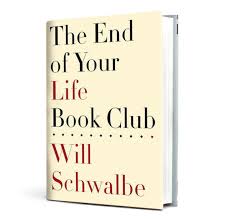
A Book Book


There's an up side and a down side to reading a book about books.  On one hand, it's about reading; on the other, by the end, my "need to read" list had grown again.

I first heard of Will Schwalbe's memoir in an article he wrote for the New York Times, I believe, describing the "book club for two" he shared with his mother while waiting with her for her treatments after she was diagnosed with pancreatic cancer.  Schwalbe was an avid reader from childhood, growing up in a family of readers.  The time he spent with his mother, especially once she faced chemotherapy, naturally lead to talk about what they were reading. They decided to choose books to read and discuss together over the course of what was more than a year of her illness. 

They alternated between recent publications and classics, mostly but not entirely fiction.  Often each would choose a title, and they would swap the two before discussing them. Among the titles they shared were Elizabeth Strout's Olive Kitteridge, Alan Bennett's The Uncommon Reader, Eliot's Murder in the Cathedral, Lahiri's short story collection Unaccustomed Earth, Geraldine Brooks' People of the Book, Randy Pausch's The Last Lecture, and Sheila Weller's Girls Like Us, all books I'd read and enjoyed, many with my book club.  They also read Maugham, John O'Hara, Joan Didion, Alice Munro and many more. 

Along with their readings, he writes about his own reading life and their discussion of other books, stories, and poems they had read--Mary Oliver, Lewis Carol, Nancy Drew and Gone With the Wind.  Throughout the time they have together, his mother's spiritual faith counters his own doubt or disinterest in religion.  She keeps her copy of Daily Strength for Daily Needs by Mary Tileston throughout her illness, a year's worth of daily devotions.  Their reading often deals with death, though he is often reluctant to talk about his mother's own imminent death.  He also reads material that help him to consider how best to bring up topics.  (Don't, for instance, ask a terminally ill person "How are you doing?"  Ask, instead, "Would you like me to ask how you are feeling today?")

The book provides much good for thought, not only about reading and death but life, love, family, and faith. As I read, I not only marked passages to which I hoped to return, but I started my own list in the back of works mentioned that I wanted to read myself.  Once I reached the end, I found that the author had thoughtfully included a list of works discussed, which I would have found if, like Schwalbe's mother, I had always chosen to read the end first.


Share/Save/Bookmark